

What’s the first thing you do after the news of having triplets begins to sink in? You Google. You Google every question you can think of. And there are A LOT of questions.
One thing you quickly learn is that triplets are rare and when something is rare the information is hard to come by. We have spent hours researching online, reading blogs from other parents of multiples and watching YouTube videos of healthy and happy triplet babies. Since we have had so many questions about the babies from family and friends, we decided to put together some of the most interesting facts we have learned so far.
Delivery
- Average gestational age at time of delivery is 32 weeks
- Average birth weight for triplets is 4lbs 1oz.
- Average NICU stay is 18-19 days
- Average days in the hospital is 22-23 days
Zygosity
- 80.7% of triplets are all fraternal
- 2.9% of triplets are all identical
- 11.6 % of triplets are a combination of identical and fraternal
- Types of triplets:
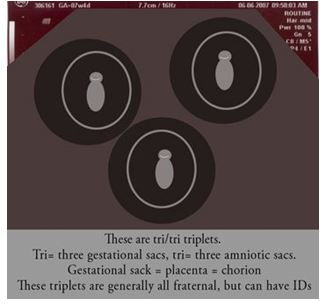
- Trichorionic/Triamniotic (tri/tri) triplets:
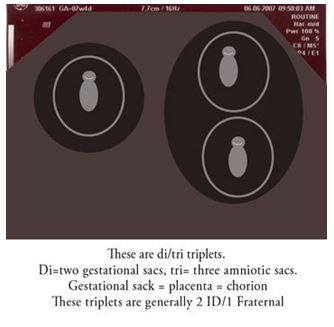
- Dichorionic/Triamniotic (di/tri) triplets:
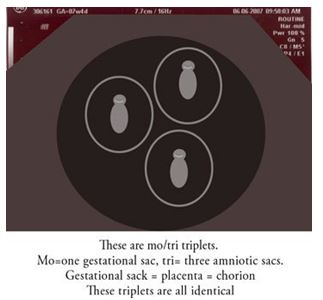
- Monochorionic/Triamniotic (mo/tri) triplets:
- In addition to the three types of triplets listed above, there are also Monchorionic/Monoamniotic (mo/mo) triplets. Essentially these are triplets who are sharing not only one placenta, but they are also sharing one amniotic sac. This is extremely rare.
Gender
- 49.51% of triplets are female
- 49.36% of triplets are male
Random Facts
- Identical multiples exhibit almost identical brain wave patterns.
- The rate for identical, or monozygotic, multiples is random and universal; it’s the same in all populations regardless of race, heredity or other factors, and it has remained constant over time.
- Twins and multiples have been known to develop their own ‘language’ that only they understand. This is known as cryptophasia.
Cost of raising triplets for the next 18 years
- Still too afraid to Google this one.
We will know more about what type of triplets we are having next week so stay tuned!

 B Plus 3